
Cruising Japan: When to Sail, Where the Ships Go, and How to Choose Your Voyage
Japan is the fastest-rising cruise destination in Asia — a genuine four-season country where a single voyage strings together ancient capitals, active volcanoes, atomic-memory cities, and subtropical islands. The two headline windows are cherry blossom in late March and April and autumn foliage in October and November, with May and October the all-round sweet spots for weather and value. All nine major cruise lines sail it, from 5,000-guest mega-ships to 400-guest luxury yachts, on voyages from four nights to a month. In every port the meal is half the destination — Kobe beef, Hiroshima oysters, Nagasaki’s invented noodles. This guide covers why Japan is better by ship, when to sail, how long to go for, what you’ll see and eat, which lines fit you, and how the pricing works.
You wake to the ship easing past a green headland, a smoking volcano off the bow, and a city of two million sliding into view — and by lunch you are eating black pork at a counter where the chef cooked it in front of you. That is an ordinary morning on a Japan cruise.
Japan cruising at a glance:
• Best time: late March–April for cherry blossom, October–November for autumn foliage; May and October give the best weather-to-price balance.
• How long: anything from 4 nights to a month, with most voyages running 8 to 16 nights.
• Embark from: mostly Yokohama (the working “Tokyo” port); luxury lines also use Tokyo; winter Okinawa loops sail from Naha.
• The fleet: all nine major cruise lines, from 5,000-guest mega-ships to 400-guest luxury yachts.
• Cost: priced by season more than by cabin — the blossom and foliage weeks carry a clear premium; early summer is the year’s best value.
• Demand: Japan drew roughly 1.8 million international cruise travellers in 2025 — a fifth more port calls than the year before.
• Good to know: nearly every Japan loop adds one foreign call — usually Korea or Taiwan — because maritime law requires it.
Why cruise Japan rather than tour it?
Because Japan’s headline experiences are spread across 2,000 kilometres, and a ship moves you between them while you sleep. Land touring the same route means repeated hotel changes and long rail days; a cruise gives you one unpacking and a different region each morning.
The clearest example is cherry blossom. Bloom moves south to north over roughly a month — in the 2026 forecast Tokyo reached full bloom around March 27, Kyoto around April 1, and Sapporo not until late April. A land trip books one city and one week, and gambles on it. A ship follows the bloom up the country, so a mid-April voyage can still find blossom on its northern legs after the petals have dropped in Tokyo. Autumn works the same way in reverse.
It also solves Japan’s quiet difficulty for first-time visitors: the trains, the language, and the logistics are handled. You step off in Nagasaki, spend the day, step back on.
When is the best time to cruise Japan?
The two best windows are late March to April for cherry blossom and October to November for autumn foliage, with May and October the all-round sweet spots — near-peak weather at below-peak prices. The season runs roughly February to early December.
Because Japan spans 2,000 kilometres north to south, no single week is “peak” everywhere. That is the whole art of timing a Japan cruise.
Cherry blossom (late March–April) — the premium window: The most-wanted and fastest-selling weeks of the year.
Bloom is a probability, not a date, and forecasts only firm up from January. An early-April departure is the safest hedge for the Tokyo–Kyoto corridor. These sailings fill far ahead and price up — reserve the previous summer or autumn.
Late spring (May–early June) — the reliable sweet spot: Fine, mild, after the spring rush and before the rains.
You give up the blossom and gain the calmest seas and easiest port days of the year, usually at a friendlier fare than April. For first-time cruisers, this is the window we point to most.
Summer (June–September) — festivals, and the honest trade-off: The great matsuri land here — Kyoto’s month-long Gion Matsuri in July, Aomori’s Nebuta fire floats in early August — and fares are the year’s softest.
The trade is weather. The tsuyu rainy season runs early June to mid-July (grey drizzle-days rather than washouts), and July–August turns hot and humid, around 29°C in Tokyo. Then the real caveat: of roughly 30 typhoons forming in the Northwest Pacific each year, 7 to 8 pass over Okinawa and about 3 reach the main islands, concentrated in August and September. An itinerary weighted toward Okinawa and Kyushu in those months carries the highest chance of a re-routed port day. The ship almost always outruns the weather — but know how your line handles a substitution before you book.
Autumn foliage (October–November) — the smart-money twin: The second peak, and the connoisseur’s choice.
The colours reach Tokyo and Kyoto in late November and deliver scenery as dense as the spring blossom, with fewer crowds and often better value. October pairs post-typhoon calm with the season’s second-best weather. If April prices you out, take this.
Winter edges (February–early March) — the value play: The full range of ships at the season’s softest fares.
The season opens in February and closes in December as the fleet repositions to Southeast Asia. Okinawa stays mild enough that subtropical loops run all winter. A repeat visitor chasing value can do very well here
Where do Japan cruises go?
Most Japan cruises are round-trip loops from the Tokyo area, calling at six to ten ports down one coast and up the other. Because of a maritime rule called cabotage, foreign-flagged ships must also call at one foreign port — usually South Korea or Taiwan — which is why about nine in ten itineraries show one non-Japanese stop. It is a legal requirement, not a filler day.
Your embarkation hub is almost certainly Yokohama: Despite the “Tokyo” label on most brochures, the working turnaround port is Yokohama, which handles the large majority of cruise embarkations in the Japan market. From the city-centre Osanbashi pier you are a seven-minute walk to a train station and ten minutes from the historic Red Brick Warehouse district. The neighbouring Tokyo cruise terminal is the luxury marquee, where Silversea, Regent, and the smaller premium ships turn.
Each port carries one signature day:
• Nagasaki — the most-visited cruise port in the country; a four-century crossroads of Japanese, Chinese, and European history.
• Hiroshima — two UNESCO World Heritage sites in one day: the Peace Memorial, and the “floating” torii on Miyajima.
• Kagoshima — “the Naples of Japan,” across the bay from the smoking Sakurajima volcano.
• Kobe and Osaka — the two gateways to Kyoto, Japan’s old imperial capital.
• Shimizu — the Mount Fuji viewing port (with an honest caveat below).
• Naha, Okinawa — the subtropical south, with its own island culture and the rebuilt Shuri Castle.
• Hakodate and Aomori — the cool, scenic north: hilltop night views, morning seafood markets, and one of Japan’s great fire festivals.
How long should a Japan cruise be, and what kinds are there?
Japan sails at every length from 4 nights to a month, and the most common voyages run around two weeks. Japan rewards length more than most destinations, because its regions differ genuinely from one another.
• 4 to 7 nights: a focused taste of one region — the least common shape here. Good as a first cruise or bolted onto a land trip.
• 8 to 11 nights: the popular middle — the marquee ports without the full circumnavigation.
• 12 to 16 nights: the classic “Circle Japan” loop, and the sweet spot for a first full visit.
• 17 nights and beyond: grand voyages, often continuing to Korea, Taiwan, or Alaska. More common in Japan than in most destinations.
Itineraries then sort into five recognisable shapes:
• Classic Japan — the Pacific-coast marquee run. The default first voyage.
• Southern Islands — Kyushu and Okinawa, on the majority of Japan itineraries. Subtropical, and the reason Japan cruising works in winter.
• Northern Japan — Hokkaido and Tohoku. Cooler and wilder; best in summer and early autumn.
• Sea of Japan — the quieter west coast, and the least-sailed of the five. The repeat visitor’s route, and where the luxury lines concentrate.
• Grand and festival voyages — two weeks and up, often timed to blossom, foliage, or a named festival. The only shape that reaches every region in one trip.
Deployment shifts each year, so which shapes are offered on your dates varies — ask us to check what is actually sailing when you want to travel
What will you actually see and do?
A Japan port day is unusually rewarding because so much sits within walking distance of the pier — and because the food is as much the destination as the sights. The honest framing: on a single day call, pick two anchor experiences and do them well rather than chasing five.
Kyoto, from Kobe or Osaka: The old capital’s temples, geisha districts, and gardens are the headline of any Japan cruise, and Kyoto sits about 51 minutes by direct train from Kobe. On an overnight call — Kobe is Japan’s most overnight-friendly port — Kyoto is comfortable. On a day call, two sites is the honest maximum. Kobe itself is the under-sold half: an old treaty port, a famous sake district, and a harbour visibly rebuilt after the 1995 earthquake.
Hiroshima and Miyajima: The Peace Memorial Park and Museum is the morning; the floating torii on Miyajima is the afternoon, a thirty-minute boat from the port. You cannot do both at depth in one day — choose your centre of gravity and let the other be a glimpse.
Sakurajima, from Kagoshima: The city ferry crosses to the active volcano every fifteen minutes, around the clock, for about ¥250 — which makes standing on a live volcano one of the great cheap thrills in cruising. The crossing is the photo session: the city behind, the smoking cone ahead, your own ship in the frame.
The Nebuta festival, from Aomori: If your northern call lands between August 2 and 7, Aomori parades enormous illuminated floats through the streets at night — arguably the single best port day in the whole Japan product. Outside festival week, the year-round Nebuta museum sits five minutes from the gangway.
Kanazawa’s gardens and gold: Kenrokuen ranks among Japan’s three great landscape gardens, alongside samurai and geisha districts and a living craft tradition — you can apply gold leaf with your own hands in a one-hour workshop. One tip the locals know: visit the garden first thing, before the coaches arrive.
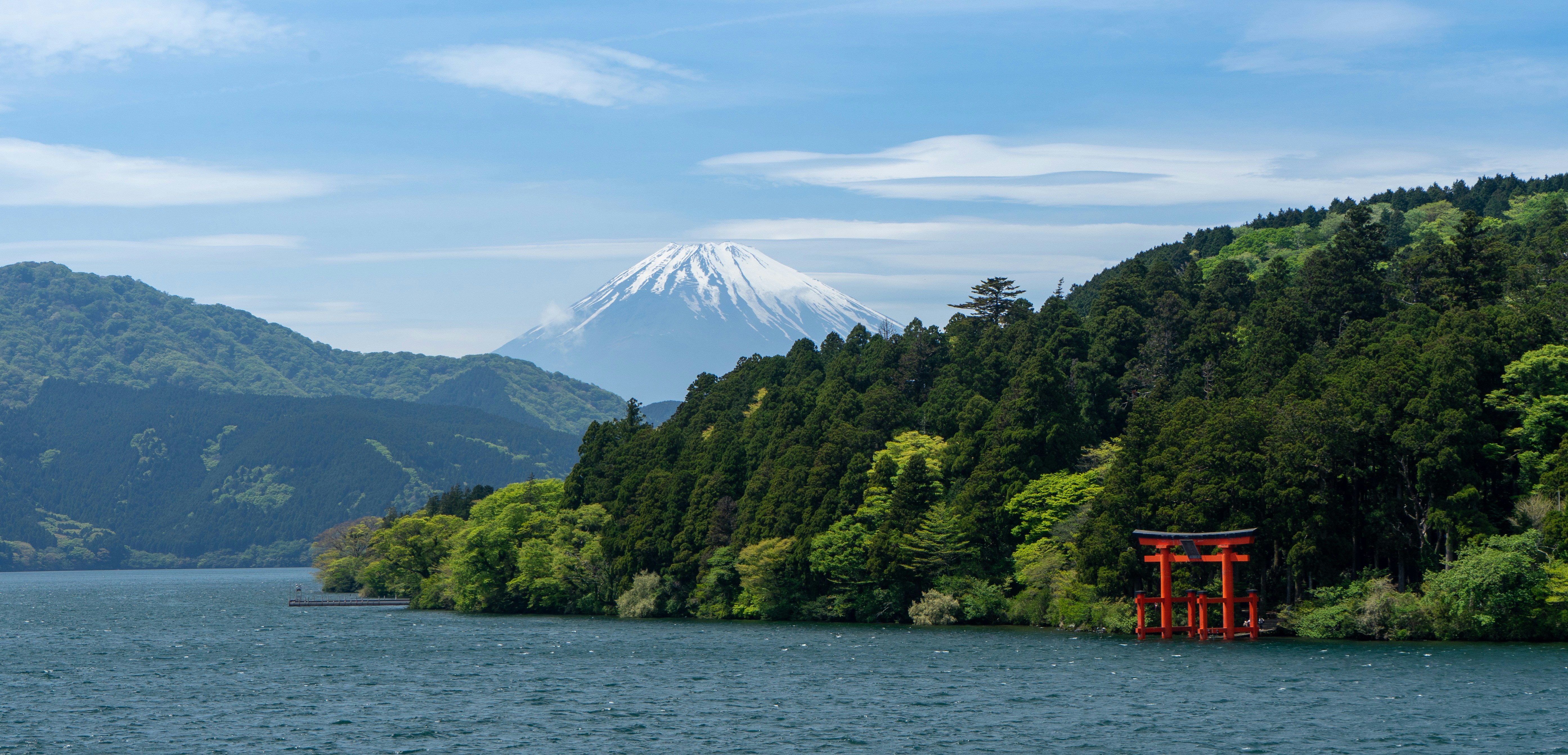
About Mount Fuji: Shimizu is the Fuji viewing port, but the mountain is 37 kilometres away and shows itself on its own schedule — visible on roughly 60 to 79 percent of winter days but only 10 to 20 percent of summer days. Treat it as a gift, not a guarantee.
What to taste, port by port. In Japan the meal is the souvenir, and each port has a dish that is also a history lesson:
• Kobe — certified Kobe beef teppanyaki at lunch, when the same cut runs a fraction of the dinner price.
• Hiroshima — layered okonomiyaki and grilled oysters from the bay; maple-leaf cakes and conger-eel rice on Miyajima.
• Nagasaki — champon, a noodle dish invented at a restaurant that still stands beside the cruise terminal, and castella sponge cake, baked here since 1624.
• Kagoshima — black Berkshire pork, fried fishcakes, shaved-ice dessert, and sweet-potato shochu.
• Aomori — build your own seafood bowl at the morning market, then try the local oddity: miso-curry-milk ramen.
• Kanazawa — a seafood bowl from a 300-year-old market topped with sweet shrimp, and a gold-leaf soft-serve cone.
Which cruise lines and ships sail Japan?
All nine of the major cruise lines sail Japan, spanning 5,000-guest mega-ships to 400-guest luxury yachts. The choice comes down to two things: how big a ship you want, and how much you want included in the fare.
Mainstream and premium big-ship: Princess runs the deepest Japan program by far, with the Diamond Princess and Sapphire Princess — about 2,670 guests each, and the Diamond Princess homeported near Yokohama for most of the year. Both were launched in 2004 at the Mitsubishi yard in Nagasaki — the only large modern cruise ships ever built in Japan — refitted in 2019, and each carries an Izumi Japanese bath onboard, so the ship itself is part of the Japan experience. These are the amenity-rich, value-friendly sailings most first-timers start with. Royal Caribbean’s Spectrum of the Seas (4,900 guests, launched 2019) is among the newest big ships in the region; Celebrity’s Millennium (launched 2000, fully refurbished 2019) and Norwegian’s Jade (launched 2006, refurbished 2017) are smaller and older, and price accordingly. Within this tier, ship age is the most useful signal you have — a recently built or refitted hull simply feels different from one that has not been touched in a decade.
Small-ship luxury: Silversea’s Silver Muse (launched 2017) and Silver Moon (2020) carry just 596 guests each, all-suite with butler service throughout. Regent Seven Seas’ Seven Seas Explorer (2016) and Seven Seas Splendor (2020) carry 750, also all-suite. Oceania’s flagship Vista (2023, 1,200 guests) is the line’s first new ship in eleven years. All of them trade waterslides for included excursions, finer dining, and slower “deep Japan” port days — and on Regent in particular, excursions, drinks, and gratuities are built into a single fare.
Subtropical and year-round: MSC bases the 5,650-guest Bellissima (launched 2019) in Naha, Okinawa, running warm-weather island loops right through the winter when the main-island season quiets.
One honest note: Cunard’s Queen Elizabeth (launched 2010, refreshed 2025) is a fine ship but currently carries only a token Japan presence. If a specific line matters to you, check it actually sails your dates before building a trip around it — deployment changes every year, and we can confirm what is scheduled for the dates you want.
How much does a Japan cruise cost, and what’s good value?
A Japan cruise prices to its season more than to almost anything else — so the smartest savings come from choosing the right week rather than the cheapest cabin. Fares move constantly with demand, so rather than quote a number that will be wrong by the time you sail, here is how the pricing actually behaves.
Season is the biggest lever. The cherry blossom and autumn foliage weeks command a clear premium and sell furthest ahead — which is exactly why blossom-motivated travellers book the previous summer or autumn. Early summer is the year’s softest pricing, the trade being the rain and typhoon risk covered above. The February-to-early-March edge opens the full fleet at the season’s quietest fares, with a cold-weather trade-off.
So the value map is simple: May and October for the best balance of weather and price, June–July for the lowest fares if you’ll accept some rain, and February–early March if you want the widest choice of ships at the quietest pricing.
Cabin choice is the second lever, in the usual order — inside, oceanview, balcony, suite. Balconies are the most-booked category in Japan, and worth it on this itinerary more than most: a lot of the scenery happens while the ship is moving.
And check what’s included before you compare. The fare buys your cabin, your meals in the main dining rooms, and the onboard entertainment. Flights, shore excursions, specialty restaurants, drinks, and gratuities usually sit on top — so a luxury fare that bundles excursions, drinks, and gratuities can land closer to a “cheaper” big-ship fare than the headline suggests. That comparison is the single most useful thing an advisor does for you.
Talk to our cruise specialist to match your dates and budget to the right ship and season.
Who is a Japan cruise best for?
A Japan cruise has a simple rhythm: you unpack once, wake in a new port most mornings, and get a sea day or two while the ship handles the distances. Within that, the right ship and season depend on who you are.
• First-time and value-minded cruisers: a round-trip Princess sailing — Diamond or Sapphire Princess — in May or October. Round-trip removes one-way flights, shoulder weather removes most of the risk, and Princess prices the friendliest of the big lines.
• Families and multigenerational groups: the big, newer ships with the most to do between ports — Royal Caribbean’s Spectrum of the Seas, or MSC Bellissima on the warm Okinawa loops.
• Design-led couples and food-focused travellers: the small luxury ships out of Tokyo — Oceania’s Vista for the dining, Silversea’s Silver Muse and Silver Moon for the all-suite calm.
• Ultra-luxury and all-inclusive seekers: Regent Seven Seas — Seven Seas Explorer or Splendor — with excursions, drinks, and gratuities in one fare.
• Experienced Japan travellers: the Sea of Japan and northern routes, or a grand voyage of two weeks-plus — the shapes that reach the ports most first-timers never see.
• Solo travellers: any of the above, but ask about the single supplement before you book — it varies sharply by line, most of all on the luxury ships.
- Cherry blossom peaks late March to mid-April, moving south to north. In 2026, Tokyo was forecast to reach full bloom around March 27 and Kyoto around April 1, with the northern island of Hokkaido not blooming until late April. An early-April departure is the safest hedge for the Tokyo–Kyoto corridor. Bloom dates are probabilities that only firm up from January, and blossom sailings sell out far ahead — book the previous summer or autumn.
Do Japan cruises leave from Tokyo?
- Almost all "Tokyo" departures actually sail from Yokohama, the working turnaround port that handles the large majority of Japan embarkations, about 30 minutes from central Tokyo. A smaller number of luxury sailings use the Tokyo cruise terminal itself. Check your specific sailing, because the embarkation pier changes your first-day logistics.
Will I see Mount Fuji on a Japan cruise?
- Maybe — and that honesty matters. Fuji is viewed from the port of Shimizu, but it sits 37 kilometers inland and is often hidden by cloud: visible on roughly 60 to 79 percent of winter days but only 10 to 20 percent of summer days. Treat a clear Fuji as a wonderful bonus rather than a guaranteed sight.
Are Japan cruises affected by typhoons?
- They can be, mainly in August and September, and mainly on itineraries weighted toward Okinawa and Kyushu. The ship itself almost always outruns the weather; what flexes is the occasional re-routed port. If you sail in late summer, ask how your cruise line handles a port substitution — the good ones re-route in-country and refund affected ship-booked excursions to onboard credit.
How much does a Japan cruise cost?
- On a typical 10-to-14-night Japan loop, a balcony cabin runs roughly $215 to $345 per person per night, with inside cabins from about $145 and suites from about $310.† Season matters most: spring blossom and autumn foliage sailings carry a notable premium over the May and early-summer shoulder, where the best value sits. Fares move with demand, so confirm current pricing for your dates.
How long do you get in each port?
- Most calls run a full day, roughly eight to ten hours ashore, with some lines scheduling overnight stays at marquee ports like Kobe (the gateway to Kyoto) to give you a real evening in port. On a single day call, plan two anchor experiences rather than five — Japan's ports reward depth over rushing.
Which cruise lines sail Japan?
- All nine of the major lines NAVICRU tracks deploy to Japan, from mainstream big-ship programs like Princess (with the Diamond Princess homeported near Tokyo) to small-ship luxury lines like Silversea and Regent, to MSC's year-round Okinawa loops. The choice comes down to ship size, included extras, and whether you want a wide-ranging big-ship loop or a slower, deeper small-ship voyage.
† Pricing and ship-deployment figures are ranges drawn from NAVICRU's live sailing inventory, last refreshed June 11, 2026; fares move with demand, so confirm current pricing for your dates.
Written by the NAVICRU cruise desk · Last updated June 12, 2026 · port information verified through June 2026. Built from a continuously updated cruise knowledge base and live sailing inventory — most travel guides are refreshed only every few years.
This guide was prepared with AI assistance from verified cruise-port data. Details like festival dates, prices, and seasonal closures can change — confirm anything time-sensitive before you sail, or ask our cruise specialist.